The End of Heroes

Updated: Jun 9
Scott Hamilton
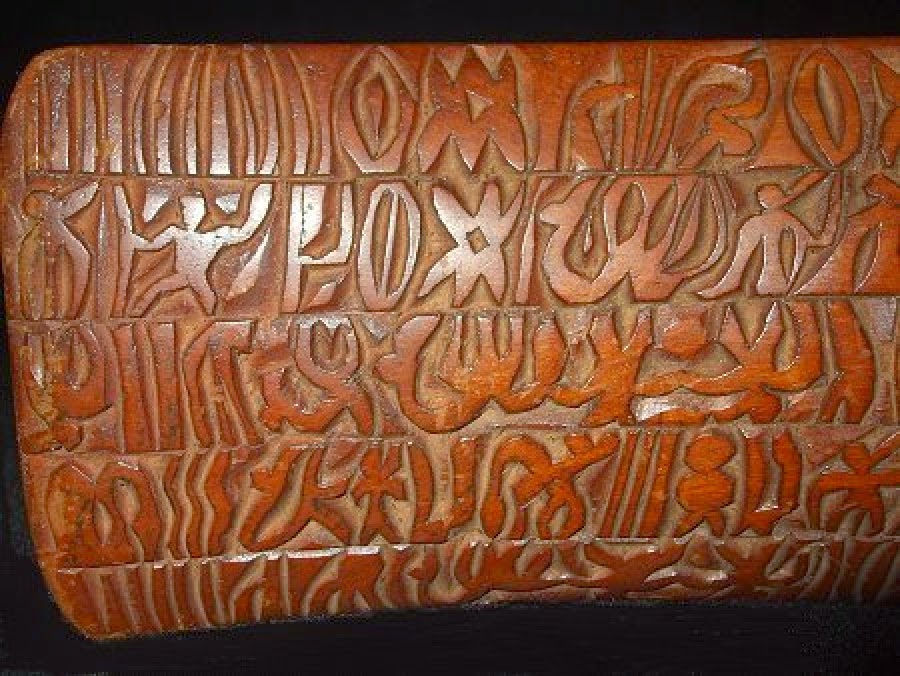
RS: Reef Shark wants to champion the art and lifeways of Oceania, which preserve ways of thinking, acting, and being that have been marginalised or abolished in the 'wealthy' countries of the northern hemisphere, where capital and technology rule. But as well as documenting Oceania we will publish analyses and excoriations of the failed civilisations of the West and China.
1: 'All that is solid melts into air'
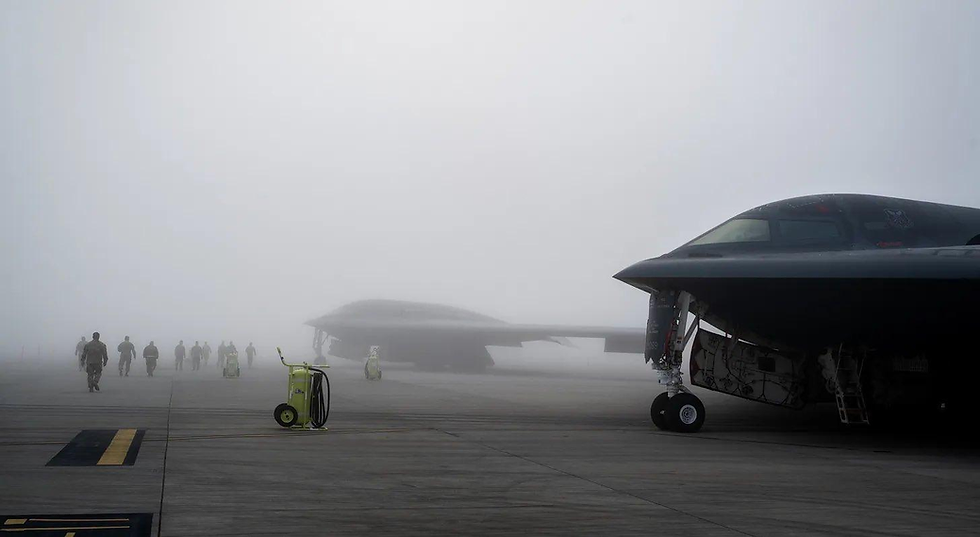
I can't stop looking at this photo, which has been published alongside a number of news articles about the war on Iran. American aviators walk towards their B2 planes. The B2 has been named the Spirit Bomber by the American air force. The aviators are turning into mist.
The photo was taken at a base in Missouri. The B2s take off there, then steer across the Atlantic and over the Mediterranean and into the Middle East, flying at nearly twice the height of Everest. Layers of cloud and smoke insulate them from Iran. By the time the bombers arrive back in Missouri they have spent thirty-seven hours in the air. The hatch of the nearest plane is open. A short ladder beckons.
When I look at the figures moving down the runway I think of Keith Douglas, a soldier-poet who died in northern France a few days after D Day. In his last poems Douglas had trouble distinguishing the living from the dead. Watching columns of soldiers massing on the English coast, he saw them as 'ghosts' who were 'wandering' towards Europe. 'A shadow is a man', Douglas wrote, 'when death...approaches'.
The B2s dwarf the aviators walking towards them. The nearest plane is as solid as the pilots are insubstantial. We cannot see the aviators' faces, but recognise the B2's sharp beak and opaque eyes. B2s are like the Stymphalian birds that Greek myths located in the swamps of Arcady. The birds flew from their watery bases to steal grain and poison farmland. Their feathers could become deadly projectiles: missiles or bombs.
Even if we could see the aviators on the runway, we wouldn't recognise them. The pilots fighting in twenty-first century warzones like Iran and Ukraine are anonymous figures. Military press releases hail their deeds but omit their names; their faces are often blurred in official photographs. It was different in the twentieth century, when war pilots could become as famous as sports stars. During both world wars the faces of flying aces like Germany's Erich Hartmann and America's Richard Bong adorned newspapers and magazines, and girls' bedroom walls. Fighter pilots were modern knights, jousting in the clouds.
Richard Hillary was badly burned after being shot down during the Battle of Britain. His memoir The Last Enemy described the ecstasy of flying as well as the terror of war. It became one of the most popular English-language books of the forties. Writers and painters saw both military and civilian pilots as symbols of freedom, who had escaped from the restraints and rules of the earth. In a tribute to an Irish fighter pilot, WB Yeats wrote of how 'A lonely impulse of delight/ Drove to this tumult in the clouds'.
In the twenty-first century there are no fighter aces, no duels between knights of the clouds. Pilots stare at screens as often as the sky, and their movements are relentlessly monitored and directed from the ground. They cannot see the men and women they kill. Some pilots fighting Iran do not even leave the ground: they fly drones from egg-shaped capsules at Creech air force base, an hour north of Las Vegas in the Nevada desert. They kill then go home to sit with their families at the dinner table.
The photo I've been talking about is credited to the 'US Air Force Image Library'. There are no details about who took it, or where it was taken. Perhaps the photo was not even made by a human: perhaps it was one of the millions of still images generated every day one of the surveillance cameras mounted at air force bases. War photographers, like war pilots, have become obscure figures in the twenty-first century. There is no contemporary figure to compare with Robert Capa, whose images of the Spanish Civil War and World War Two made him as famous and admired as Picasso. Crouching in foxholes and running with attackers, Capa and his peers photographed men and women fighting and dying at close quarters; sometimes they fitted both sides of a battle into the same frame.
There is no place for Capa's methods in the Iran war, where combatants kill each other from inhuman distances. Many images of the war are curiously deserted. The violence of missiles and bombs is shown, but the victims of these devices are absent.

2: Fascist Aesthetics Redux
This photo was taken on March the 6th, and shows an oil refinery on the edge of Tehran ablaze after an Israeli bombing raid. Its author is anonymous, but it has been reproduced thousands of times on websites and social media around the world. The photo has a troubling beauty. The green and orange daubs of Tehran's lights contrast with the blazing orange of the refinery. Symmetrical layers of oil-black cloud-shadow and fire-coloured light lie on the Alborz Ranges behind the city.
The mountainous blaze of the photo makes it resemble Turner's painting The Burning of the Houses of Parliament. But there is a difference alongside similarities. Turner painted the huge crowds that fled and watched the fire in London. That photo, by contrast, does not show us a single being. Awesome damage has been inflicted on Tehran, but the city might be deserted. It is all too easy to forget that the black cloud rising with the orange blaze dropped acid rain on nine million people, and made them vomit black bile and breath in carcinogenic dust.
Turner's champion John Ruskin said that he painted the 'sublime': scenes whose vastness and violence made viewers feel terror as well as wonder. The terror was essential, Ruskin argued, to the empathy Turner wanted his viewers to experience. Turner's painting Slavers Throwing Overboard the Dead and Dying combines human and natural violence: the slavers are trying to the lighten their ship as a typhoon approaches. Looking at the work, we feel the horror of the slave trade and Turner's disgust at his fellow human beings.
The photo of Tehran's burning refinery aestheticises massive violence in a way Turner never would. The Trump regime has encouraged this beautifying of massive violence. Five days into the war it released a video that cut between scenes from Hollywood movies and video games and scenes from Iran: missiles flying, bombs dropping, fires burning prettily. This 'trailer' for the war on Iran has had tens of millions of views.
The video would have pleased Filippo Marinetti and his Futurist movement, which presented war as a form of art, and saw the Mussolini dictatorship as an ally. When Italian planes bombed Ethiopia during the conquest of that country, a Futurist pilot wrote about the beauty of destruction. He dropped a bomb of a group of Ethiopians, watched them run in all directions, and imagined a flower opening its petals. The Trump regime and the MAGA movement offer an American revival of Marinetti's fascist aesthetics. But there is a sense in which they go far beyond the Futurists.
In 1991 Jean Baudrillard published a small book called The Gulf War Never Took Place. The book was ridiculed by a number of journalists who never read it. They imagined Baudrillard as some sort of crazed conspiracy theorist wanting to denying that Bush and Saddam had fought a war.
What Baudrillard was arguing was that war had fundamentally changed in the era of global television. America now fought wars, he suggested, with as much concern for spectacle as for outcomes on the battlefield. In 2026 Baudrillard's argument seems prophetic. Trump's war on Iran seems headed for disaster, with the Strait of Hormuz closed and over a dozen American bases wrecked, but many of the president's supporters, who have been consuming the spectacle of the war, remain convinced he has triumphed, and are baffled and angry at reports and opinions that contradict their view. Just as aviators are subsumed by the B2, and reduced to ghosts in its machinery, so Americans are imprisoned inside a Futurist spectacle.
_


Hi Scott. Re this, first Baudrillard. Yes, I read his book on 'Simulacra', an idea he got from a short (very) by Borges. His argument re the Gulf War was that (when he was asked if he wanted to report from Iraq etc) due to massive mediation (or media of course, and it more the case now even) that it was better to watch the represented world and the war in this case on (then Television, now it is massively stranger online etc, but the principles are similar) or via the news mediation: and if he went to the place of the war, it would be less significant that if he reported what was 'mediated' as indeed everything is, on…