From Mussolini to Britney Spears to Mayan Glyphs: a Talk about Translation with Jack Ross

Scott Hamilton
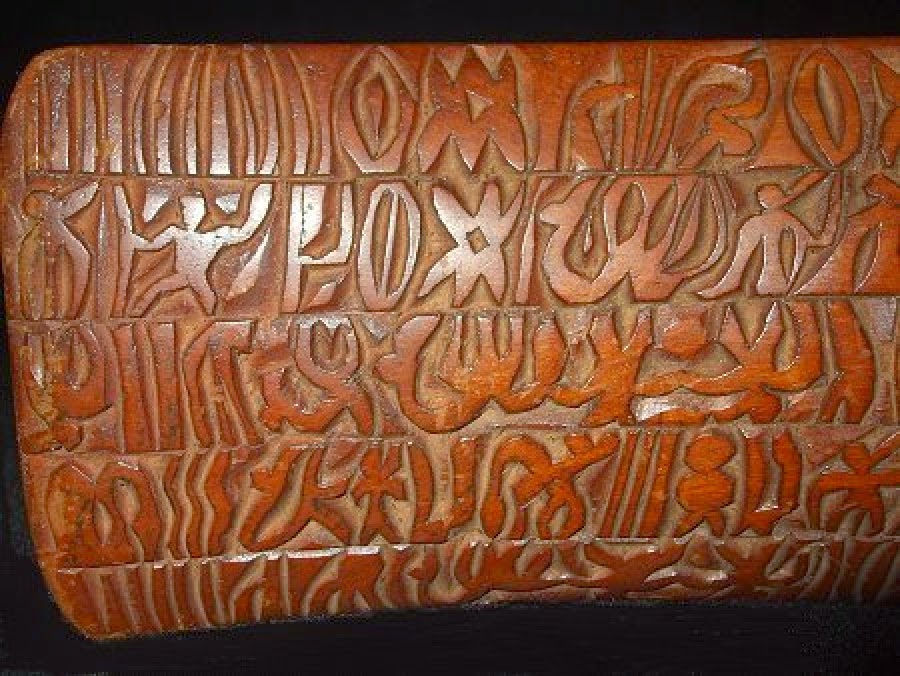
Jack Ross has been one of Aotearoa's key experimental writers in the twenty-first century, exploring many different literary forms and drawing on many cultures. This is the second in a series of interviews in which Ross lifts the lid on his toolbox, sharing techniques that can be alternatives to the hegemony of a dreary realism in Aotearoan literature.
SH: You've been a prolific and very adventurous translator, tackling many different writers from many different languages. I wanted to ask you about the small book Pound's Fascist Cantos that you published in the '90s, because we're unfortunately living through a period when fascism seems to be resurgent. There's even a group in Italy that calls itself Casa Pound after the poet. Ezra Pound wrote the two cantos you translated late in the war, when he was still making radio broadcasts on behalf of the Mussolini regime to the United States. He attempted to suppress the pieces, leaving them out of the books where he collected the other cantos. What made you want to bring them to light?
JR: I’m sorry that this may turn out to be quite a roundabout answer, but singling out that one chapbook like that does make it sound a bit as if I’d planned it as a propaganda exercise. But that wasn’t what interested me about those strange wartime cantos of Pound’s. I guess what attracted me to verse translation in the first place, in the early 1990s, was the fact that I’d just finished writing a long piece of critical work, my Doctoral thesis on European descriptions – or recreations – of South America. This entailed reading a great deal of Latin American literature for comparative purposes.
At Edinburgh they still had a tradition that key texts should always be read – and cited – in the original languages, so this also meant trying to pick up a reading knowledge of Spanish. I’d studied French at school, and Italian at university. Like them, Spanish is a Romance language, but the fact that I could generally remember the term I needed in one of the other two languages was not really much help to me at the time.
Anyway, I dutifully slogged through at least one book each by the likes of García Márquez, Vargas Llosa, Manuel Puig, and a bunch of others. Quite a few of these writers use words from the indigenous languages of their respective countries – and the Spanish they speak is far from Castilian. Inevitably I missed many subtleties, but I did my best.
I have to confess to having steered clear – for the most part – of quoting from Brazilian writers because I didn’t have time to try to pick up a reading knowledge of Portuguese as well. That’s not to say that I didn’t read plenty of stuff by Jorge Amado, Machado de Assis, and Euclides da Cunha – the last named was the most important for the thesis – but only in translation, I’m afraid. So, in accordance with university policy, I supplied quotes first in the original languages, then in either a standard English translation or (if necessary) my own version.
I did enjoy it, but it was a bit of a slog. After I’d finished the thesis, I was pretty much allergic to the everything to do with its subject matter for quite a long time. I’m not sure if everyone feels so violent a reaction: quite a few go on to do Post-Doctoral studies in the same field, so I guess not. Anyway, to keep myself busy, I started working on translations from other languages instead: mostly French and Italian to start with, but eventually some Spanish and German as well.
My own poetry wasn’t going well at that time. I knew, on some level, what I wanted it to sound like, but I wasn’t really sure how to achieve that: I used increasingly elaborate punctuation and italics to try and get across a certain tone of voice, but it just clogged up the texts and made them unreadable – as well as having the unfortunate side-effect of emphasising process over content.
Translation offered me a way around that. I noticed, after a while, that when I was working on turning a particular stanza or line into English, I was prepared to try innumerable versions of it to make it fit into the overall structure. I began to realise that the problem with my own poems was that I wasn’t doing that: I wasn’t working hard enough on them: the phrasing, the structure, the meaning. I kept on trying to prop up my initial tricks of wording rather than revising and changing them to make them work better.
So how does Ezra Pound come into all this? I guess mostly because I bought a new copy of The Cantos (the fourth, 1987, edition) when I moved to Palmerston North for my first teaching job, and that was the first time I’d ever come across his two Italian cantos. They weren’t in the earlier editions I was used to reading. No translation of either of them was supplied in context, so I thought I’d better have a go at making one myself for my own uses. It was a chance to dust off my rather rusty Italian, and – in true Academic fashion – I also wondered it mightn’t offer me a chance to get a leg up on some of my more linguistically challenged contemporaries.
There’s some awfully dull stuff in The Cantos. So far as I’m concerned, it only really comes to life after the war, with The Pisan Cantos, written on a borrowed typewriter while he was imprisoned as a fascist sympathiser. The Italian cantos come just before that – written at the height of his enthusiasm for the Duce and the Axis cause. I’d say that poetically they’re probably a slight improvement on the earlier John Adams cantos, but their subject matter is odd to say the least.
If you’re at all interested in Pound and his poetry, it’s hard to overlook them. Anyway, after I’d done a version of them, with copious annotations justifying some of my bolder conjectures, I decided I’d try to publish them somewhere. So I wrote to James Laughlin at New Directions, asking if he’d give me permission to do so.
He replied very politely, but in the negative. There was a reason they were included in the latest edition of the Cantos in Italian only. The family and the trustees didn’t want them available in translation. Ah well, at least they’d beguiled many a weary hour in the muddy fields of Massey University (they’d housed me in an old prefab out the back, as there wasn’t room for me in the main building) …
But then Laughlin wrote to me again. Apparently, in the meantime, an Italian scholar called Massimo Bacigalupo (the son of Pound’s old dentist) had just published a complete annotated translation of both Italian cantos in the Pound journal Paideuma. This was a blatant breach of copyright, Laughlin said, and he was planning on suing. Under the circumstances, though, he withdrew any objections to the publication of my own version – though ideally its distribution ought to be confined to Oceania.
I asked Alan Loney if he’d like to print my translation as part of his ongoing series of handprinted Holloway Press books. He did seem interested, but Peter Simpson, the managing editor, must have decided against it – I guess because it had no real local associations, which is reasonable enough, but also (I suspect) because there was a certain air of controversy about it.
So I decided to make a little chapbook of it, and distribute it myself. It seemed easier to do that rather than having to explain to each new potential editor or publisher just why I wanted them to promulgate this deplorable set of verses. I added my version of Rimbaud’s “Poets at Seven Years Old” to the book as well because I thought it had a similarly rebellious air to it.
Rimbaud, after all, renounced poetry altogether in his late teens and instead decided to try and live out his most extravagant fancies in Africa. He may not have actually been a slave-trader, but it was not for lack of trying. He was certainly a gun-runner. He died miserably from cancer in his forties, having more or less reenacted the trajectory of his own famed “bateau ivre” (or drunken boat). He seemed good company for Pound, who did some excellent early translations of Rimbaud lyrics.
SH: A lot of lovers of poetry have had ambiguous feelings about Pound. On the one hand, he revolutionised and reinvigorated English-language poetry early in the twentieth century, giving it a new freshness and flexibility, and making even the greatest poets of the nineteenth century seem suddenly outmoded. By juxtaposing precise and carefully chosen images and dispensing with long-winded linear narratives and laborious word painting he got us thinking as well as writing in new ways. Some critics have suggested he invented the hyperlink many decades before the internet. But Pound's conversion to fascist politics and the anti-semitic ranting in the Cantos and in his radio broadcasts has seemed for some readers to contaminate all his work. He avoided the death penalty for treason after World War Two because psychiatrists decided he was insane, but many commentators have considered that a copout. Do you think Pound ever renounced fascism in his later life? Does it matter, for readers of his work? Was his suppression of the fascist cantos the product of remorse, or was it cynically motivated?
JR: Pound certainly repented of his antisemitism in his later years. He said that the wonderful Olga Rudge, his longterm partner, had eventually forgiven him, but it took quite a while, I’m not sure he ever really was a fascist by conviction. It was just that his own particular self-concocted brand of economics happened to accord with what he saw as Mussolini’s ideas for a time in the 1930s and 40s.
He mostly fell silent after he left the asylum in Washington D.C. in the late 1950s. It was hard to get him to say anything at all. His daughter, Mary de Rachewitz, who really was a raving fascist, and who wrote the memoir Discretions about her father, took care of him for a while at her home in Italy.
Pound may have been many things, good and bad, but he certainly wasn’t an opportunist. A quixotic, misguided idealist is what he was – and a true eccentric. It does raise the issue of having to assess the writers we read in political terms before we’re allowed to enjoy them, though.
I have my own politics, of a leftist nature – if you opened me up, I’m sure you’d find the fatal word “WOKE” incised on my heart – but I find it quite difficult to use this as a touchstone when judging poetry.
Dante Alighieri was a political reactionary whom I’m sure I would have violently disagreed with if he were alive now. Conversely, I have great sympathy for John Milton’s republican politics, but far less for the tenor of much of his work.
It’s not that I think that politics should stay out of poetry – more that, while it has to be there, it’s always going to be just one part of a more complex set of judgements. I like to know as much as possible about the writers I admire: their personal histories, their prejudices: it helps me to appreciate and – I guess – interpret their work. This is particularly important for the ones I’m attempting to translate.
Pound has much to teach us still – if we want to write well. Or at least that’s what I’ve found. I don’t really have to like him or approve of all his actions to find him interesting. His economic and political views may seem terrifyingly naïve, but at least they involved real problems which he was making an honest attempt to solve. Like so many other writers, he also had problems with mental illness. I don’t actually think it was a cop-out to put him in an asylum rather than hanging him at the end of the war.
Judge not lest ye be judged, they taught us when we were children. If a prosecuting attorney was rummaging through my entire life with a fine-tooth comb with an eye to a quick conviction, I doubt that they’d find it too difficult to find enough material.
SH: In 2001 you published an extraordinary book called The Britney Suite, which brought together translations from the work of Paul Celan, the Holocaust survivor and great poet, and Britney Spears. It was a startling and potentially very controversial juxtaposition. I think I remember you saying that a distinguished Celan scholar had visited your blog and expressed puzzlement over The Britney Suite. What were you trying to do with the book?

JR: I suppose I could come up with a lot of fancy reasons and excuses, but the fact is that I was a great fan of early Britney (“Oops, I did it again”), and one day it struck me that I probably wasn’t the only overeducated geek who’d much rather meet her than have a heartfelt exchange with Heidegger.
In particular, since I was in the early stages of my Paul Celan fixation, I felt sure that there was a side of him that would have greatly relished such an encounter.
The poems rather wrote themselves after that. I spent a lot of time on the translations – albeit conscious all the time that they were less cribs than adaptations – and the rest just coalesced around them.
It was the late Pierre Joris, whose massive two-volume translation of Celan’s collected poems is now a standard text for English readers, who found all this lunacy on my blog.
He commented (and I quote):
Maybe I have spent too much time these last 40 years thinking about Celan & translating his work, & maybe Celan's work has been too essential for my own writing for me to have a detached view on this, but the association of PC with Britney Spears makes me shudder ...
I answered him to the best of my ability – trying to convey the depth of my own respect for Celan, I guess. But what really surprised me was finding other writers such as Jen Crawford leaping to my defence.
I don’t think he bore any grudges. Later on he left a comment on a further post of mine itemising all the extant translations of Celan into English:
Glad to have your selection of Celaniana to send people to. & thanks for the good words re my translations. Wish you could be at the performance presentation “Paul Celan—Pierre Joris: Celebrating 45 Years of Translation & Reflection” I'll be giving at Harvard in November, backed by Nicole Peyrafitte’s audio-visual collages.
So it was, in the end, really the most amicable of exchanges. Oops, I did it again …
SH: The Britney Suite was followed in 2012 by a larger book called Celanie, in which your translations of Celan poems were presented alongside artworks by Emma Smith. Celan's poems have often been called obscure by critics. His syntax is often tortured, and his imagery can be deeply personal, even hermetic. And the tragedies of his life - his time in a Nazi labour camp in World War Two, the murder of his mother by the Nazis, his breakdowns and depressions and ultimate suicide - loom in the minds of readers of his work. Was translating Celan an intimidating task? Did you have a sense of the fragility of the poems?
JR: Oh my God yes. What effrontery to undertake such a thing! It was just that I’d picked up a kind of taste for his tortured syntax and immensely charged-with-meaning wordplay after working on those five late poems from Schneepart [Snow-part] I included in The Britney Suite. I wanted to do more, but I had no obvious pretext to do so.
It wasn’t till another eminent translator, Michael Henry Heim, whom I ran into at a conference, recommended that I read Celan’s correspondence with his wife, the artist Gisèle Celan-Lestrange – it had just been published in French in two sumptuous volumes – that I suddenly saw a way forward.
“You do speak French, don’t you?” Heim asked me. (He clearly didn’t think much of my linguistic capabilities). I admitted I did. “Well, you’ll find all you want in there.”
He was right. Gisèle Lestrange’s German (like mine) was pretty limited, so Celan had to explain the poems he was constantly sending her in letters before she could understand them. And he was very, very anxious that she did understand them – it seems to have equated, in bis mind, with understanding him.
As a result, he included vocabulary lists for virtually all of those poems – and a Celanian glossary includes nuances of meaning that are not in any dictionary. More than that, though, he also included complete literal French versions of many of the poems.
It’s worth noting that he was one of the greatest translators of his time: two volumes of his collected works are devoted entirely to his versions from English, French, Hebrew, Italian, Portuguese, Rumanian, and Russian. So far as I can judge, the results are impeccable: and he picked some pretty difficult poets to introduce into German: Marianne Moore, Eugenio Montale, and Osip Mandelstam – just to stick to the “M’s”.
There are 88 poems included in the body of the Paul and Gisèle’s correspondence, and I tried to translate all of them. Or rather, tried to find my own English poem somewhere in the gap between Celan’s German poem and his French adaptation of it.
The result has been variously judged. The readers I’ve talked to about it seem to like the book. One reviewer accused me of turning the poems into what he called a kind of “Celan-lite”, with the cragginess and difficulty we associate with his work smoothed out and made overtly lyrical. He may well have a point. But all I was really aspiring to do was to flesh out my own understanding of his work. I’m still proud of some of the versions in there.
SH: In recent years translation has become part of the West's ongoing culture wars. Translators of Homer, in particular, have been accused of not being faithful to the poet's texts - of adding meaning to them, often for political reasons. Usually these accusations have been made on social media by culture warriors who have big audiences but no expertise in ancient Greek. Implicit in their accusations about 'woke' translations is the idea that a text can be transferred perfectly, without any change in meaning, from one language and era to another. The translator's role therefore has no creative component - she or he is a sort of xerox machine. Stephen Davies, who lectured in the philosophy of art for many years at the University of Auckland, had a very different view. He insisted that a translation was only authentic if it contained something new. Davies referred to musical traditions to make his point. In folk music traditions, he said, performers are expected to add their own interpretation to an old song they are playing. Without such an interpretation the song is inert, and inauthentic. And when we look at the most famous translations of Homer into English we see that they reflect the ways of writing and thinking that were prevalent when they were made. Alexander Pope's translation of the Odyssey, for example, was made in the eighteenth century, and uses the heroic couplets that were popular then. But for me part of the fascination of the translations of a work like the Odyssey is the fact that they are so various. I don't feel like I have to choose one over another - I feel that I'm approaching Homer's epic from different angles, and getting different insights. And so I like Davies' definition of translation.
JR: It’s funny. I had an argument about precisely this subject with Richard Reeve the first time I met him, at a poetry symposium in – of all places – Bluff. He was denouncing Christopher Logue’s versions of Homer, published in War Music and various later volumes. I said that I’d been to a one man show based on War Music while I was living in Edinburgh which I found utterly electrifying.
“Maybe so,” he riposted. “It might be a nice performance piece, but you can’t possibly call it Homer.”
“I’ll tell you what you can’t call Homer,” I said. “You can’t call some set of clumsy English hexameters put together by some Academic Ancient Greek expert who never wrote an original poem in his life, ‘Homer’. It may resemble the form and even the content of the original, but it’s not a poem in any sense of the word. Give me Christopher Logue any day. At least he is a poet, and a bloody good one too.”
I think Reeve saw that I had a point. In any case, the conversation grew quite amicable after that.
So, yes, I’m in complete agreement with Stephen Davies on this point.
It’s a pretty old argument, though. The locus classicus for of it is probably still the Lowell / Nabokov dichotomy. On the one hand, we have Robert Lowell’s 1961 book Imitations, where some of the most famous poems in the European literary canon are transformed into Lowellian rants. On the other, we have Vladimir Nabokov’s deliberately dry-as-dust and over-literal four-volume translation of Pushkin’s Evgenii Onegin (1964).
If you’re trying to learn Russian, or you’d like to make your own verse translation of Pushkin, Nabokov’s work will be immensely valuable to you. But it’s not exactly a laugh riot.
Lowell’s book, on the other hand, is almost too much fun. He cuts out bits he doesn’t like – adds codas to poems (sometimes by mistake), and generally has a high old time. I love it. It’s very much the kind of thing I aspire to do when I try to turn a foreign language poem into a more-or-less parallel poem in English.
There may be some intermediate ground between a Lowellian imitation and a Nabokovian crib, though. Some master translators (like Celan – or Mandelstam) seem to be able to remain faithful to the original and still to create a recognisable poem in their own language. I’m not one of them, alas. For me, it’s Lowell or bust.
SH: You’re one of the few people from this part of the world to translate Mayan texts. The Mayans have fascinated outsiders for more than a century, but their culture and history has also been relentlessly distorted. All sorts of fantasies have been projected onto them. Their cities in the jungle has been cast as peaceful utopias and blood-soaked dystopias. Their texts have been turned into predictions of apocalypse by Europeans and Americans preoccupied by the problems of their own societies. Even distinguished writers like William Burroughs and Charles Olson have joined in the fantasising. Burroughs’ novel The Soft Machine describes a Mayan society that features mind control, powerful drugs, alien technology, and shapeshifting monsters – stuff that owes more to the pulp sci fi he loved and to his own experiences as a junkie than to historical reality. Charles Olson’s Mayan Letters was written while he lived in Yucatan, and seems like a serious attempt to investigate Mayan history, but turns out to be rely on wild guesses about the meaning of Mayan glyphs. How did you get interested in the Mayans, and how did you avoid the sensationalism and hysteria that have surrounded treatments of Mayan culture and history?
JR: I wish I were capable of translating from the Mayan. All I’ve actually done is turn some Spanish versions of Mayan texts into poems of my own. It’s true to say that I have a great interest in Mayan civilisation and culture, however.
Michael Coe’s great book Breaking the Maya Code gives a fascinating account of one of the greatest intellectual feats in history: deciphering the meaning of the Mayan glyphs. Their complexity truly beggars belief – Egyptian hieroglyphs and Sumerian cuneiform are child’s play by comparison. But a whole slew of different people in different places gradually put together a schema which enabled them to read them with reasonable accuracy for the first time since the Spanish conquest.
The results are strange, very strange. Another writer on the subject whose work interests me greatly is the American scholar and translator Dennis Tedlock. His description of Mayan poetics raises issues that should concern any literary legislators.
Mayan writers almost never use verbatim quotes. Instead, they rephrase the rough idea of a poem or statement without using the same words. It’s as if everything in their literature is paraphrase – the idea of “original wording” means nothing to them. The same is true of the glyphs, incidentally: there are many, many ways of writing the same word or letter – and no particular onus on the scribe to repeat the original notation when it’s recopied somewhere else.
I suppose, on the one hand, that’s good news for translators. It’s a bit of slap in the face for literary essentialists, though. Maybe it’s possible to conceive of literature in terms which don’t valorise so much the precise character of the “original” as the cultural shockwaves it sets up around it.
Food for thought from the Ancient Mayans. Try reading the Popol Vuh sometime if you want to see it in action. It’s hard to see very much continuity between the various translations – but the ideas behind the work somehow transcend all that, apparently.
SH: I’m keen to ask you about still-undeciphered scripts, especially the Indus Valley script and rongorongo from Rapa Nui. I find the Indus civilisation really interesting because it is so enigmatic. Some people think it may have been a utopia, egalitarian and relatively peaceful, whilst others suspect the opposite. All of them are working, of course, on the archaeology alone. The lack of differentiation in their cities, the apparent absence of palaces, is very intriguing. Wouldn't it be ironic if humans worked out how to get along with each other and created something close to a decent society, right at the beginning of history, and then lost the formula in shifting sands? But an archaeologist warned me about jumping to conclusions: 'We used to think Mayans had a peaceful society. Then we deciphered their script.'
Rongorongo tablets are such beautiful objects, and it's so sad that they were encountered by outsiders only in 1864, two years after slavers bound for Peru had devastated Rapa Nui society and removed the men who had used the tablets. There are so many questions about rongorongo. Was it an old, independently created system of writing, or a mnemonic device, perhaps inspired by the 'treaty' signed with early visitors? There's evidence both ways - one of the tablets has been dated to the 1400s, but wood was very scarce on Rapa Nui so it's possible that piece of wood had been used for other things and had only been given glyphs after contact with outsiders. The glyphs don't anything look like the written language the people of Rapa Nui encountered in the 1700s, which is odd if they were created in response to the example of that language. But on the other hand written language has been such a rare invention in human history - is it credible to think that a small group on an isolated island had the idea? New evidence from rat bones and from the languages of French Polynesia suggests that Rapa Nui was not quite as isolated as had been supposed, and of course there's the stunning new evidence for some genetic admixture with South America (which surely must have come from Polynesians bringing wives/captives/curious new friends back after visiting that continent). Oral tradition, which was itself badly disrupted by slaving and disease in the 1860s, holds that the settlers of the island brought rongorongo with them. And if rongorongo is a mnemonic device or a form of proto-writing then this doesn't seem so fanciful, especially because its glyphs resemble carvings and paintings in many parts of East Polynesia.
JR: I don’t really know anything much about Rongorongo tablets beyond the – violently disputed – comments about them by Thor Heyerdahl in his still very readable book Aku-Aku: The Secret of Easter Island (1957). While I didn’t find his theories very convincing even back then, he certainly tells an interesting tale, and did have the advantage of being on the spot, some seventy years ago, and recording some very interesting reminiscences.
Oddly enough, I was once at a dinner party where I met an elderly German man who claimed to have just returned from a long sojourn on Easter Island where he had completed what he said was a definitive decipherment of the Rongorongo tablets. I’m afraid I wrote him off as a crank at the time (it must have been in the mid-1990s, I guess). I suspect now that he may have been Thomas Bartel, “a German ethnologist and epigrapher who is best known for cataloguing the undeciphered rongorongo script of Easter Island,” according to Wikipedia. His ideas, too, are now largely discredited, but I can see why he was so irritated at my daring to mention Thor Heyerdahl in his company. He saw himself as a serious scholar, Heyerdahl as a publicity-mad monomaniac.
In any case, the jury still seems to be out on all the various attempts that have been made to decipher them. Given the immense conceptual difficulties behind the Mayan decipherment, I can see why.
SH: I wrote a piece for EyeContact years ago about the weird and wonderful 'translations' of rongorongo that scholars have come up with it. Here's an excerpt from one by Soviet linguist Irina Feodorova:
a root, a root, a root, a root, a root [that is, a lot of roots], a tuber, he took, he cut a potato tuber, he dug up yam shoots, a yam tuber, the potato tuber, a tuber…
I wonder what you think of the idea that, in cases like this, the text supposedly being translated is actually working like the image in a Rorschach test. The translator is actually presenting his or her subconscious. In the EyeContact piece I talked about Angus MacLise, who was the original drummer for the Velvet Underground as well as an artist and a poet. MacLise produced his own 'script', which was meant to mimic the enigmatic quality of rongorongo or Indus texts. It invited but resisted interpretation. I think that MacLise's gorgeous paintings of his script are in some ways a better response to the mysteries of rongorongo than the bizarre 'translations' of scholars like Feodorova.

JR: I guess that most obvious exemplar for this kind of thing is the famous – or notorious – Voynich manuscript. For those who haven’t heard of it, it’s a mysterious book with curious illustrations of plants and flowers and naked human beings depicted in a manner vaguely consistent with medieval alchemical manuscripts, but mainly containing hundreds of pages of indecipherable script.
The trouble with this script is that it looks as if it should be easily decipherable – just a couple of strokes away from cursive Latin or some other recognisable language. But it’s defied all attempts to read it. There isn’t even any agreement on whether it really is a script, or just an elaborate practical joke – perhaps designed to palm off some random pages on a gullible collector.
In any case, after many vicissitudes, it’s now found a home in the Yale University Library. The vellum it’s written on has been dated to the early fifteenth century, between 1404 and 1438 – in other words, just before Gutenberg built his first moveable type printing press in 1440.
I spent quite a lot of time poring over the (numerous) books about it in the early 2000s, and it helped to inspire the novella “Coursebook found in a Warzone” in my collection Kingdom of Alt (2010). I’m afraid that the hoax hypothesis seems, now, the most probable to me, but the legions of would-be decipherers now have a variety of websites where they can scan and discuss the pages one by one. Here’s one of the most useful of them: https://www.jasondavies.com/voynich/#f1r/0.373/0.422/2.00
SH: Rongorongo has also fascinated language activists in Polynesia, who have used it as the basis for suggested new scripts for the Polynesia languages. There is an artist in Whakatane who has created a script for Māori. She dislikes the way the Roman script was foisted on the language. This is a Polynesian script based on rongorongo that an enthusiast posted on reddit. The proposed script is called Papa'i.

JR: That’s fascinating about the new script for Māori. The alphabet above reminds me of the famous Cherokee syllabary, invented by Sequoyah in the early nineteenth century to write the Cherokee language. It’s estimated that by 1825 most Cherokees could read and write using the new symbols.
It’s still in use, in fact. It’s had its ups and downs over the years, but children’s books and art books continue to be printed using this script, even though it requires 85 separate characters instead of our 26.
It seems pathetic that we’re still arguing about whether or not to include macrons for Māori placenames on signposts when the vast richness of Polynesian ethno-linguistics lies all around us. It’s funny how difficult the descendants of colonists find it to acknowledge that in shifting hemispheres they should probably shift a few more of their idées fixes.


Comments