Smith’s Bush | Part 1

Vivienne Kent

RS: This is the first part of an exceptional piece of psychogeographic writing by Vivienne Kent. Next week we will post the second half of the text where we'll explain its background and talk about Kent's career as a scholar and writer.
Smith’s Bush is where I come to enter the Otherworld. The North Shore City Parks Department, however, describe it more prosaically. Smith’s Bush is ‘a rare and precious remnant of old growth forest’, one of the few left in Auckland. This vestigial woodland is surrounded by the depredations of urban life, wedged between the Northern Motorway and the tennis courts, cricket and football fields of Ōnewa Domain. At its southern border is a reclaimed harbour bed. On one side there is a black-silt pond and traces of an ancient swamp. On the other is Akoranga Drive, where fast-food stores, an outlet warehouse and a garage jostle for business. Auckland’s traffic howl fades as you click the gate and tread softly along the boardwalk that takes you into the interior of the bush. The trees, mostly smooth-trunked pūriri and feathery, grey-green kahikatea, create a high canopy so dense that only a dim greenish light filters through, eerily underwater-like and stealthily quiet. I have seen kererū, the wood pigeon, and tui in the branches, and pīwakawaka, fantails, flit around with their distinctive diving swoops. Sometimes I catch sight of a vagrant band of Australian rainbow lorikeets, noisily foraging amongst the kahakaha, the massive epiphytes that festoon the oldest trees.
I have been coming to Smith’s Bush for many years now. The loop track of its raised boardwalk takes only thirty minutes to complete, but the entire bush is twenty-two acres in area, covered with thickets of old and young trees, shrubs, ground ferns and leaf litter. At its southern end a dirt track makes its meandering way through spreading moss, following a stream that plunges over a small waterfall and into the swamp, and then, gaining strength, rushes into the Waitemata Harbour. Ōnewa means basalt, referring to the substrate of volcanic stone that underlies the ground, laid down after the eruption of Rangitoto Island six hundred years ago. But despite the swamp, this was not originally a wetland forest. The oldest trees are the giant pūriri that grow together in a central grove; these trees were an important component of the original forest and pūriri is not a wetland tree. In the early years of the twentieth century the area was milled for straight pūriri to make into fence posts for the grazing land cleared by European settlers; the most prominent tree now in the forest is kahikatea, or white pine, a species which seems more able to re-establish itself than native podocarps such as tōtara, miro, mataī, and rimu. All this history makes the walk into Smith’s Bush a journey into the past, a palimpsest where history has been overwritten. But for me, it is also an expedition into an Otherworld of nature and time.
In Māori tradition the past lies before one, with the individual believed to live facing the experience and wisdom of the ancestors—i ngā wā ō mua, or the time in front—with the unknown future hidden behind his or her back. The modern western notion of time as a linear progression from Before to After is connected to the incarnation of Christ, which turned the faces of believers toward the future, hoping for Christ’s return in glory. Time as an unending stream of life and death, a flow of inner and outer events, feels more real to me when I am feeling oneness with nature. Time seems to stop, as it does in those stories when the protagonist enters a faery world and emerges years later feeling only a few hours have elapsed, as in the Celtic tale of Oisín and the hero Finn MacCumal.
On my bush walk I am often accompanied by my six-year-old son, Django, who has been diagnosed with several developmental disorders, the most prominent of which is Asperger’s disorder, a kind of high functioning autism. He is a synæsthete, seeing sounds as colours, and images as tactile intrusions; he has a sense of smell as acute as that of a dog; he hears voices, of people in the air, he says. The incessant noise and electric glare of the modern, consumer-driven city overwhelms him and sends him spinning into a black hole of panic. The natural world calms him, and allows him to extend his delicate antennae into the space around him. I think he can feel the energy fields of living creatures and connect with the thrumming of the xylem and phloem, the pumping internal life-rhythm of the giant trees. Immediately we walk into Smith’s Bush Django’s body changes shape, he stops hunching his back, he lifts up his face to the gentle filtered light, and he stops shouting, which he does to be heard over the echoing noises inside his own head. In the underwater-like muted sounds and half-light of the forest he can unwind and look around, no longer defensively keeping things out.
Django often feels socially excluded, an alien in the company of children his own age who are leading ‘normal’ lives and enjoying the ‘normal’ satisfactions of life in twenty-first century western civilization. Django can comfortably understand the moods of Tulip, our bull terrier, and is irresistibly drawn toward the company of animals in preference to people. Unless, that is, people respond to him in an open, uncomplicated way, quietly, and with expressions of genuine emotion and unfeigned interest. The natural world of forests, running water, filtered light, and the sound of birdsong is a place where he feels at ease, where he can shrug off his defences against bright lights, explosive noises, and incomprehensible social conventions. Until such time as we can move out of the city, places like Smith’s Bush are havens where Django and I can replenish our stores of resistance against the dark arts of materialism and the tyranny of social convention which prescribes the correct ways of being in the world.
Having a child that is so different from the normally accepted ways of living in our particular culture presents a challenge. The conventional approach is to try to train the child, like a recalcitrant wild animal, into becoming a simulacrum of a ‘normal’ child, teaching him or her to mimic the ways of children who are born able to negotiate the emotional minefield of social interactions. Some of this is of course desirable, as Django could easily grow up socially ostracised and already he sometimes feels lonely and notices his exclusion from his most of his peers. To this end he attends social skills classes, and takes a low dose of medication that suppresses the wildest excesses of his sensory sensitivities, but I worry that by these means his creativity is also attenuated. Oliver Sacks recalls that Robert Lowell once told him about taking lithium for his bipolar disorder, saying: ‘I feel much “better”, in a way, calmer, stabler – but my poetry has lost much of its force.’ Perhaps there will always be a trade-off for Django, where it is sometimes worth paying the price for calm, and if he misses the frenzy of emotion he will have to learn to finely-tune his chemical balance. Certainly his whole physical, emotional and mental being is very delicate and easily thrown out of whack by exhaustion, conflict, stress and certain sensory stimuli. I hope that by teaching him that a walk in the woods is an important aid to rebalancing through reconnection with the earth and communion with the trees I am giving him a valuable method of natural calming, more constant than medication.
According to Colin Ross, a maverick psychiatrist who runs a psychological trauma treatment centre in Dallas, Texas, trees communicate with each other and animals by means of energy fields that communicate presence and knowledge. Ross studies what he terms the disease of modern civilization, the way that modern men and women are dissociated from the knowledge of what he terms ‘spirit power’, the roots of which lie deep in the body and the natural world. To Ross, studying and communicating with trees is a key to reversing this disconnection; trees touch with their energy fields, enabling a fluidity of consciousness in humans and other animals that can allow them to connect with sources of energy in the landscape and the cosmos. Ross believes that regular walking in the wilderness provides more than exercise for the body, as it re-establishes physical, sensual and intuitive ways of knowledge, unseating the dominance of the ‘normal’ industrial state of consciousness that is usually fixed in place and validated by most science.
I have spent most of my life living in big cities in many different countries, but wherever I am I have always felt drawn to the wilderness. To me, trees radiate a spiritual connection to nature. Along with years studying the humanities and the human sciences I have had a parallel fascination with different ways of knowing; something deeper and more ancient, more intuitive and sensual, and something more rooted in the natural world of immediate sensuous experience. For years this search for meaning drew me to shamanism, mythology, rituals and spiritual cosmologies, but the essential connection is much more earth-bound: the smell of leaf-mould and moss, the sound of water, the feel of tree-bark and the sight looking upward from the ground toward a high canopy of ancient trees. As Dylan Thomas says, ‘the force that through the green fuse drives the flower’ keeps me alive in a way that is not only physical but is an umbilicus to the various ways of being alive on earth, and my particular connection to harmony.
A Walk in the Woods
Let me take you for a walk in the woods with Django. Once again I open the gate, the latch clinks, and the Otherworld lies before us as we face the ancient forest. The sunshine is snuffed out and the shrieking traffic is muffled as we cross the threshold into the crepuscular greenness. We step between two tall, slender kahikatea trees, and walk over a small wooden bridge that crosses a trickle of stream, and the Otherworld sucks us into its submarine stillness, the muted light under the canopy lulling us into slow motion, as if swimming underwater.
I immediately undergo a shift in perception, feeling that I have shrunk in size as I stand under tall kanuka trees and clumps of slender kahikatea. I notice a difference here between Django and myself. He unfurls and somehow seems to expand, his senses fanning out around him, no longer needing to shield himself from the rude, shrill, gaudy shackles of outside. He lifts his arms and races toward the fork in the track where the enormous five-trunked pūriri tree stands at the portico of the Cathedral Grove, where he waits for me in the golden-green gloom, motes of dust sparkling in the shards of light. I have meanwhile gone into a kind of meditation space, where I feel myself physically slowing down but with my mind still flitting around, often having odd rhymes pop up, or disappearing down philosophical worm holes. I am hearing the words of the 'Corpus Christi Carol', a medieval poem: ‘Lully, lulley, lully, lulley / The falcon hath borne my make away’. Django, though, seems to experience a fusing of his inner and outer worlds whereby he is really in the present moment. Perhaps this is because he is an intensely visual thinker and does not suffer from a chattering internal monologue; the voices he hears come from outside his own head, he says, and they do not talk to him incessantly, only when they have something important to say.
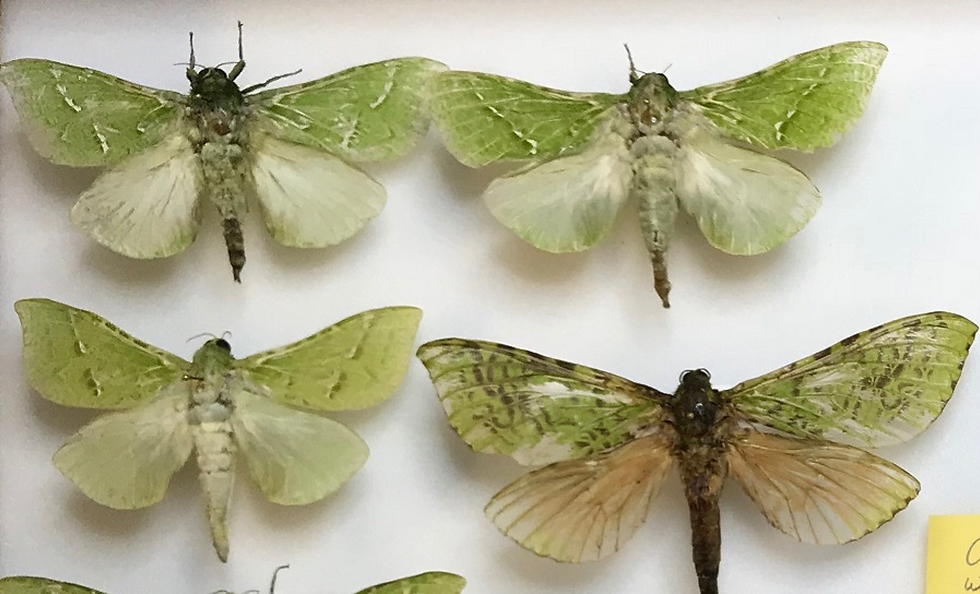
We pause, looking up at the heavy clumps of kahakaha swathing the pūriri branches. These ‘tank lily’ epiphytes, so-called because they hold a lot of water, catch more light on their leaves by growing high up in a tree. The massive trunks of the pūriri are covered with holes and scars made by the larvae of the large, furry, pale-green pepetuna moth, which spend their five-year life cycle eating fungi and burrowing through their hosts. The openings of the tunnels carved by the larvae are concealed with webs made from silk and tiny pieces of chewed bark. When we come to the fork in the track we turn right and go around the boardwalk widdershins; this is always Django’s choice and he always chooses the same direction. Django notices that one of the karaka trees has epicormic shoots sprouting from the bark, which is what happens when adequate light reaches the ground; he delights in pointing it out.
As the track bends further to the right, Django looks up at the light-gap in the canopy, created by a massive storm that bought down many large branches. Several tree species are competing to re-claim the light-gap. ‘He bare him up, he bare him down / He bare him into an orchard brown’ goes the Corpus Christi Carol. We drift dreamily past a large porokaiwhiri tree and a pale-barked māhoe, which Django loves to be reminded is the world’s largest violet; bulky akakaikū, or passionfruit, vines drape over the kahikatea trees, amid swathes of akakiore, or jasmine, and puawānanga, clematis. Thread ferns and a fine bamboo-like grass surround the track, and the earth is covered with leaves, the tough glaucous undersides of those from the taraire trees conspicuous amongst the skeletal remains of other species. A small subsidiary track branches off here, and we follow it around to the small waterfall. The boardwalk disappears, becoming a muddy trail that curls through large trees down towards the old harbour bed. Django walks over the shallow top of the waterfall, loving the sound of the water, the sight of the thick, green moss, and the smell of the leaf mould.
We return to the main loop track, which now turns sharp left near a large tōtara tree. There are two different fern tree species here, one a silver ponga with silver undersides to the fronds and silver stipes, and the other a large black tree fern or mamaku. The mamaku has very black, furry stipes, like a tarantula’s legs, says Django, and very large, green fronds. Django becomes energised around this part of the forest, which is full of tree ferns, small ferns, and rope-like vines; he likes it because it seems prehistoric, like another more ancient world. We often hear tui and bellbirds around here but rarely see the birds, their songs drifting invisibly down from the canopy. As we walk around, Django tells me the names of the trees and shrubs, asking me the names of anything he does not know, but he knows most of them. He likes the boardwalk because it feels safe, elevated above the leafy detritus of the forest floor and as we walk around it the trees appear in their expected places, ready to be familiarly greeted like old friends. As we pass another māhoe tree we are surrounded by a thicket of slender kahikatea and Django looks out for one of his favourite markers by the track: two kahikatea which have grown close together and fused branches so that they spell the ancient runic symbol for Hagalaz, meaning hail, or icy rain. Why this wintry sign should be written in our subtropical woodland is a mystery, but as creatures that take pleasure in reading meaning into random events we enjoy some imaginative speculation. Django squirrels away facts and is always surprising me with his esoteric knowledge.


Comments