Forgetting the Pacific Connection

Updated: Aug 12
Scott Hamilton
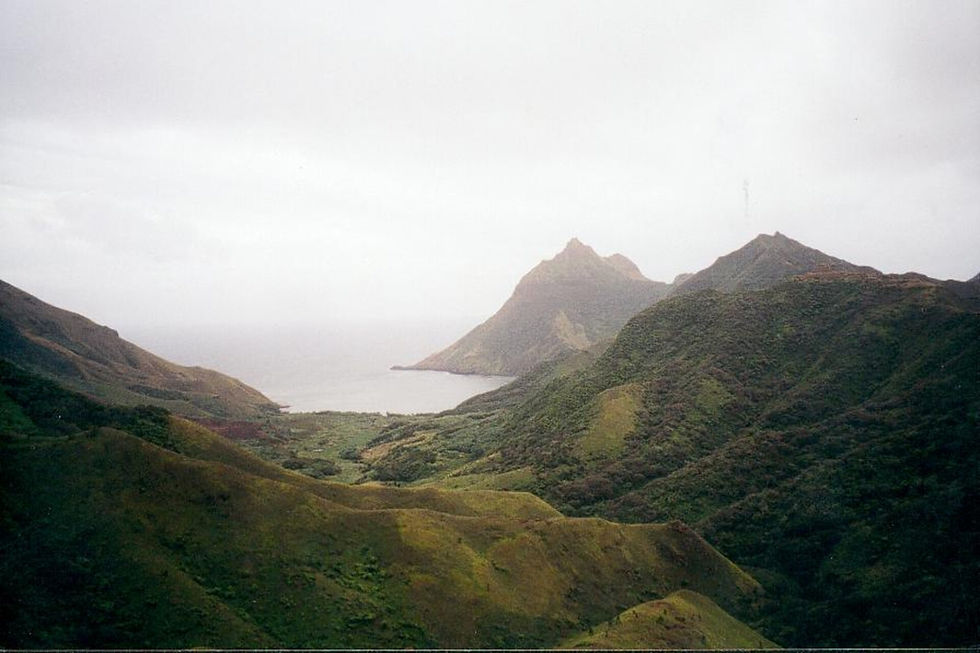
In an article published in the May-June issue of New Zealand Geographic, Kate Evans asserts that 'across Polynesia, pā are extremely rare'. I don't think her magazine has many readers in Rapa Iti, which is just as well, because they'd be pretty confused by that claim. Rapa Iti island is famous amongst archaeologists for the spectacular terraced forts that top almost all its hills. Visitors to Rapa Iti have often remarked on how much the island resembles Aotearoa's far north, where hill forts are also ubiquitous. Rapa Iti is not an isolated exception to Evans' claim. For many centuries the indigenous peoples of the tropical Pacific built forts on both their hills and their flat lands.
Along with photographer Adrian Malloch, Evans has documented the work by archaeologists and mana whenua at a swamp pā near the Waikato River and the sacred maunga of Taupiri. I worry that both Evans and the people she is documenting are making two false assumptions about pā.
Links to the Pacific
The first and more baffling assumption is that forts with earthworks are unique to Aotearoa. They are an ancestral feature of both Western and Eastern Polynesian cultures, and have been documented in many places, from Rapa Iti to Tonga to 'Uvea.
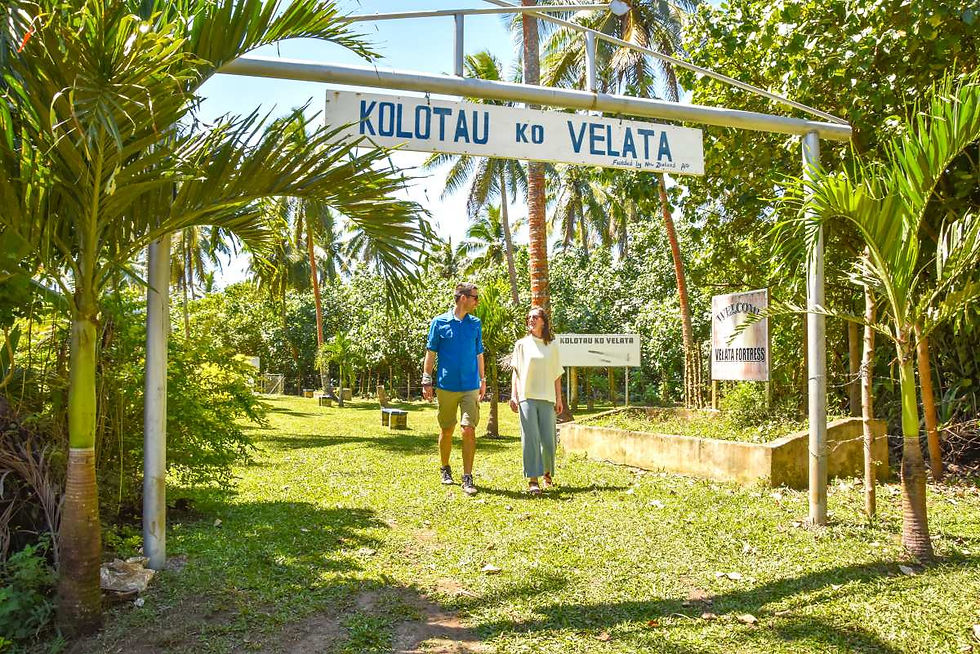
This photo shows part of a famous fort in Tonga's Ha'apai islands called Kolo Velata. It was here in 1826 that the young Wesleyan chief Taufa'ahau won a battle that set him on his way to become the first king of modern Tonga. A Berkeley graduate student named Anthony Marais wrote an entire thesis about Kolo Velata, relating it to similar structures in other parts of Polynesia. Like the pā Evans visited, Kolo Velata was constructed on level terrain. I visited it in 2018 with the Tongan sculptor and authority on tradition Visesio Siasau. The site had been overgrown by weeds, but we used Marais' maps to navigate it, rediscovering its ditches, palisade stumps, and pits. The resemblance to the swamp pā of Aotearoa was uncanny.
Marais' text is only one part of a large literature on the forts of the tropical Pacific. One of the most influential pieces of that literature is Simon Best's superbly titled 1993 research paper 'At the Halls of the Mountain Kings: Samoan and Fijian Fortifications'. Best treated forts as a sort of language, with a syntax of trenches and walls, and shows how it varied locally but had the same basic structure.
Evans claims that she researched for article on pa for five years. I am surprised that, in all that time, she didn't she run into the literature on forts in the tropical Pacific.
Ancestral Skills
Fort-building was a skill the ancestors of Maori brought to Aotearoa, like carving and navigation. The oldest extant pā in Aotearoa only date to the sixteenth century. This fact may have encouraged Evans to think that fort-building was invented independently here. But knowledge of forts in the old homelands would have been kept alive at whare wānanga, and necessary skills did not die out.
Even if they were not building forts, early generations of Māori were certainly moving earth. They dug gardens and drained swamps with ditches. Kō or digging sticks are ubiquitous in the archaeological record. In the nineties Owen Wilkes documented a series of massive ditches built on a plateau between Kāwhia and Aotea harbours. Some were created to fence off gardens, while others demarcated hapū territories. Some were relatively recent, but others were ancient. Ditches like these may have been precursors of local forts.
It is also possible that forts were constructed long before the sixteenth century but lost to the sea. In his book Hostile Shores: catastrophic events in prehistoric New Zealand Bruce McFadgen has documented the destruction of early Māori communities and gardens by storms and tsunamis. Entire motu like the Manukau harbour's Paorae and Kaipara harbour's Taporapora have vanished.
Saipele's Masterpiece
Even if we assume the first pā was not dug until the sixteenth century, it is reasonable to suppose that knowledge of forts and fort-building had been preserved in Aotearoa. There are many examples of latent knowledge being retained for centuries in Polynesian history. My favourite example comes from Niutao, an atoll in Tuvalu.
German ethnographer Gerd Koch landed on Niutao atoll in the early sixties, and began recording the songs, dances, and stories of its people. Keen to document songs associated with the island's old, pre-Christian religion, he befriended its last follower, a man named Saipele. Saipele initiated Koch into the religion, teaching him its taboos and its rituals, and helping him coax performances of old magical songs out of elderly islanders. When Koch had to leave Niutao Saipele had an astonishing gift for his friend and disciple.
Niutao had no tradition of artistic carving—the island was too small and arid to supply the timber that carvers needed. But Saipele made Koch an exquisite statue of a turtle, a traditionally sacred creature. Scholars have noted the similarity between Saipele's sculpture and the carvings of islands with historical connections to Niutao, carvings like the famous tino aitu figures of Nukuoro and the carvings of the goddess Hikule'o in Tonga. Saipele drew on latent knowledge when he made his first and last sculpture.
Lessons from Pouerua
There is another and more serious false assumption in Evans' article. She describes how Warren Gumbley and other archaeologists involved in the work at Taupiri are excavating palisades from the swamp where the pa was built and testing their age in the lab. The team at Taupiri has found one hundred and thirty-two posts.
But is such an assumption too hasty? Could it be quite unjustified?
Evans' article includes a potted history of the archaeological study of pā in Aotearoa. She notes how there was little digging at pā in the seventies and early eighties, partly because tangata whenua had been alienated by archaeologists who did seek their consent and cooperation. But Evans doesn't mention the most ambitious and successful of all the excavations of pā, which was done at the Northland maunga of Pouerua in the eighties and early nineties, under the leadership of the University of Auckland's Douglas Sutton. Sutton worked with rather than against the wishes of local hapū, and the data he gathered filled three large volumes. He was able to reconstruct centuries of pā construction, extension, and repairs. No ditch or wall or pit was dug at Pouerua without eventually attracting the attention of Sutton and his team.
Archaeologists had wrongly assumed that pā were utilitarian structures, created merely to fight wars and defend communities. New Zealand scholars had been too ready to apply European models to their country, by likening pā to the Iron Age forts of Britain. Sutton insisted that archaeologists should not assume that the artefact found most often during a dig at a pā was necessarily central to explaining that pā. And they should not rush to interpret that artefact literally—to assume it had only a functional role at the pā. Sutton also warned against looking at pā in isolation from monumental structures found in tropical Polynesia. They were not sui generis.
What does a Gun Mean?
We can get a sense of the importance of Sutton's points if we think about the monuments of twentieth century Aotearoa.
Many of our country's Returned Services Asoociation clubs have pieces of artillery outside them. These big guns are artefacts from Anzac history—often they were used by Anzacs, or captured from enemies like the Ottomans and Germans. They now act as symbols of our military past, as links to history.
Imagine an archaeologist who dug up an RSA site a thousand years in the future, and then interpreted the guns according to functionalist doctrine, assuming that they had been used to defend the RSA club from attack. Such an interpretation would be absurd—and yet it would follow from the logic that Kate Evans endorses in her article.
The Importance of Symbols
Symbolism is central to every human culture. Symbols interpret the world for us, and guide our thinking and behaviour. They were just as important in ancient Polynesia as they are today.
In his acclaimed studies of Samoan architecture, Albert Refiti has shown how every feature of a building in that society supported a set of meanings as well as use. Samoan fale were symbolic recreations of the universe outside them. An expert like Refiti can read them like books, finding meaning in the smallest and most apparently functional detail.
In the same way, the wharenui of a marae offered and continue to offer not just a source of shelter and a place for meetings but a complex set of symbols that help its users orientate and understand themselves. The ancestor carved on a wharenui's tekoteko offers symbolic solace and protection, just as the building's roof offers literal protection from the weather. Why should we assume, Doug Sutton asks, that pā were not as important symbolically as wharenui?
At Pouerua Sutton developed a new interpretation of pā. He argued that they were a type of monumental architecture, meant to express symbolically the mana of their builders, and likened them to the stone marae complexes of tropical Polynesian societies like Tahiti and Rarotonga. Sutton warns against assuming that pa were always built for military purposes, or as places where people could live. Pouerua is enormous, and many of its features cannot be explained in terms of defence from attack or the needs of a permanent population.
Sutton points out that rangatira often had whare built for themselves on the summit of Pouerua. They choose this spot for symbolic reasons. The top of the maunga gave them a panoptic view of the realm they ruled: they could see the rich gardens of their people extending towards the large shallow lake Ōmāpere, and the network of kāinga that offered them tribute and supplied taua in times of war. Like many peoples, Polynesians associated elevation with status. On the island of Tongatapu, where there were no natural hills, let alone mountains, generations of chiefs and royals made commoners construct huge mounds where they could dwell or hunt pigeons.
It seems wrong, then, to assume unquestioningly that the palisades at the Taupiri pa were raised to defend the place against attackers. And yet, if Evans' article is accurate, this assumption underlies a lot of the work that the archaeologists are doing.
Douglas Sutton is not a universally beloved figure. Some of his archaeological work on Rekohu in the seventies has been criticised by Moriori, and he was a divisive administrator at both the University of Auckland and Waikato University. During his spell at Waikato he made headlines by pulling a PhD thesis about neo-Nazism off the shelves of the library in response to spurious complaints by one of the Nazis the thesis profiled. It is a shame that he is probably better known for the controversy that resulted from this small and foolish act of appeasement than for his years of toil and revolutionary interpretation at Pouerua.
It should be possible to seperate Sutton the person and administrator from Sutton the scholar, and to appreciate the breakthrough he made at Pouerua. New Zealand Geographic is an important magazine that has managed to survive in a tough environment for print media. It offers a bridge between the work of academics in fields like archaeology, biology, and botany and the public, and it is often used by teachers in primary and secondary schools. That's why Kate Evans' article, with its old-fashioned isolationism and its lack of regard for the subtlety of Polynesian culture, is so unfortunate.


Scott, you are misquoting to an extent that warrants a retraction. You say that the story “asserts that pā are ‘unique to this place’”. You have that wrong. In fact the story is clear that pā are found elsewhere in Polynesia, and that the pā in NZ are “an answer to problems unique to this place and these people”. https://www.nzgeo.com/stories/the-pa-builders/ I note you haven't responded to our email and have replies switched off on X which means there is no response available to those you inaccurately criticise.