Book of the Week: What's so Funny?

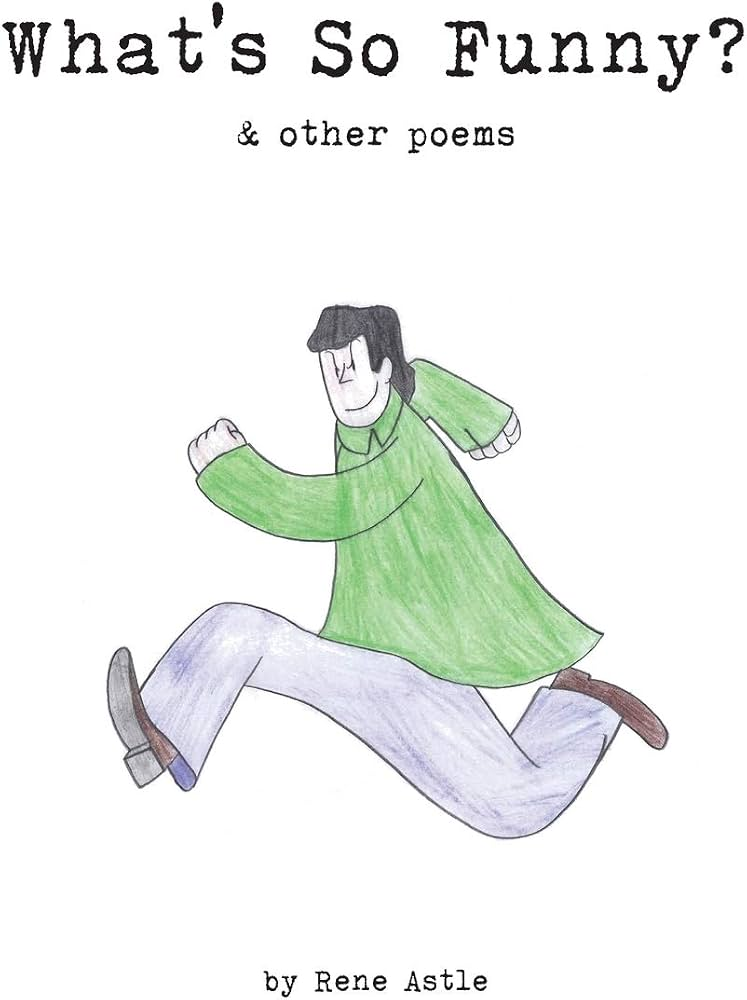
Rene Kahu Astle, self-published, c. 2020
Reviewed by Scott Hamilton
In the 2020s autism has been studied and discussed with a new intensity. For decades the condition was little-known, even among most members of medical communities. Swiss psychiatrist Eugen Bleuer defined autism in 1911, yet not only general practitioners but many psychiatrists and psychologists in Aotearoa remained unfamiliar with its symptoms into the twenty-first century.
In a factory so large
Each sardine came in a barge
Now the situation has changed, and autism suddenly seems ubiquitous. Television series like Love on the Spectrum, Atypical, and Extraordinary Attorney Woo have been runaway hits, introducing tens of millions of laypeople to autism. Newspapers and magazines run questionnaires designed to help readers diagnose themselves with autism. Celebrities with autism like Lionel Messi and Greta Thunberg have helped educate publics. Famous dead people as different as Napoleon and James Joyce have been diagnosed as autistic on the basis of their biographies and the texts they left behind. Academic research into autism has exploded.
My dog can speak in outrageous tones
Prominent in telephones
Not all the focus on autism has been good. Donald Trump and his kooky Secretary of Health Robert Kennedy have made spurious but widely circulated claims that vaccines have caused an 'epidemic' of the condition. Other conspiracy theorists have blamed everything from chemtrails to cliques of Satanists for the supposed increase in autism rates.
What has too often been lost, in the burgeoning discourse about autism, is the testimony of people who live with the condition. One morning last autumn I met Rene Kahu Astle and his mother at Glen Eden library. They have a home in nearby Henderson, where Rene's days are spent writing, drawing, and advocating for the autistic community. He has exhibited at several galleries in Tamaki Makaurau, and he has collected some of his poems under the title What's So Funny?
Rene is a tall man who thinks big. When he advocates for himself and other autistic people he is not afraid to go straight to the top. He told me about a letter he had written to America's president, and about a petition aimed at Auckland's mayor. We talked about the way autistic children were often excluded from mainstream schools in the twentieth century, and about how typical autistic behaviour has sometimes been treated as suspicious.
Rene wants society to 'meet autism halfway', by being conscious of the condition and taking steps to accommodate people with it. We talked of the way that 'open plan' classes, that bring seventy or so kids together in one big room, can be a nightmare for autistic students. 'We're prone to auditory overload' he said, and 'spaces like that turn up the noise. It's just too much stimulation.'
Rene and his mother trained themselves in managing autism when he was growing up, absorbing research on the condition and consulting local specialists, who were in short supply in the nineties. But they also trained some of Rene's teachers, making them aware of the symptoms of autism and of situations that Rene found difficult, like crowded, noisy spaces.
Rene and I talked about the slaying of autistic Americans by cops. Without training in understanding the condition, police there have mistaken autistic meltdowns for psychotic rage, and the autistic reluctance to make eye contact with shiftiness. In 2022 Christian Glass, a young New Zealand-born man with autism, was shot dead by Colorado cops. The killers had arrived after Glass called 9/11. His car had become stuck, and he was suffering from acute anxiety. Glass was too anxious to follow a cop's order to leave his vehicle. He got shot simply for clinging to the refuge of his car.
Rene loves to read, and his tastes are fascinatingly idiosyncratic. PG Wodehouse, Dorothy Parker, O Henry—many of the writers he named as favourites worked in early twentieth century America or Britain, and are somewhat neglected today. Rene also devours movies made in the first half of the twentieth century—the work of Buster Keaton is a particular favourite.
Rene's poems delight in rhyme, punning, and surreal imagery. They made me think of the verses of Edward Lear, another favourite of his, the songs of Syd Barrett, and the books of Dr Seuss. All three men have been posthumously diagnosed as autistic, and all created texts where rhyme holds together sequences of wildly whimsical images. When I read Seuss or listen to Barrett I often feel that form is dictating content: that the author is pushed forward by the need to find another rhyme, rather than by plot or argument or description.
Rhyme schemes provide structure, and love of structure is also a feature of some important works by autistic visual artists, like Andy Warhol's paintings of multiplying soup cans or the late Yayoi Kusama's arrangements of polka dots.
Autistic people often use strict daily routines to thwart the chaos of the world; does the same imposed order provide a similar bulwark in their literature and art?
People might look at me for no reason
Every day and night for every season
That's the problem of course because you see
Unlike you two, I was born in a tree...
But the paradox of literary forms like rhyme and meter is that they can be used to create disorder as well as order. When a poet lets the needs of rhyme drive their choice of words then they can escape from the tyranny of content, and open up unusual vistas. In the twentieth literary groups like France's Oulipo and the New York School used rhyme and other formal devices in this subversive way. New York School poets like John Ashbery would write in complicated forms like the sestina and the pantoum, using them to keep sense at bay.
Oulipo writers like George Perec would give themselves even stricter rules. When he wrote the detective novel A Void Perec refused to use 'e', the most common letter in the French language. The absence of the letter gives the novel a tone and feel unique in French literature. By limiting himself Perec also somehow liberated himself.
Rene's poems plunge forward exuberantly, as he follows one rhyme after another, leaving concerns about what he means behind. They feel like escapes. Instead of having to try to figure out the rules and etiquette of the neurotypical world, Rene is fashioning his own miniature realms, places where he can delight and excite himself.
I can answer the hard questions
With some brief suggestions
Like how does a small dog catch some flies
Without its bulging eyes?


Brilliant review, my poetry is geared to everyone, kids and adults alike. Rhyming poetry can be effective in their own ways, even Shakespeare wrote rhyming verses in his sonnets, songs, and plays.