Book of the Week: Scratching a Living

Peter Bromhead, Wardini Books, 2016
Reviewed by Scott Hamilton

Peter Bromhead died on August the 25th. He was 93. At his peak, when he was drawing cartoons for the Auckland Star in the late '70s and '80s, Bromhead was an Aotearoan George Grosz, a caricaturist who mocked powerful people and ideas using an artfully primitive style that perfectly complemented a caustic, proletarian sense of humour.
Bromhead's portraits of Prime Ministers Rob Muldoon and David Lange became famous, and were good enough to encapsulate their policies as well as their personalities. During an era of economic crisis, strikes, ethnic conflict, and riots Bromhead's mordant vision of his adopted homeland was widely shared. Many people bought the Auckland Star just to read his latest drawing.
I remember my father showing me a cartoon Bromhead had published the day after the snap election in 1984. Muldoon had announced the election during a drunken TV interview, and by the time he lost the New Zealand dollar had gone into freefall. Bromhead's cartoon showed Muldoon and Lange standing in a sewer with 'New Zealand' written on it. 'You can have it, Lange' the outgoing Prime Minister slurred.
Scratching a Living tells the story of a life that could be considered very unlucky or very lucky. The young Bromhead was sitting in a corner of the Portsmouth pub his mother managed when a German bomb fell on it. He was thrown a long way through the air and covered in broken glass, but somehow only suffered relatively minor injuries. Bromhead's mother had already tried to kill him when he was still small by throwing him off the top of a double decker bus. She suffered fits of insanity, and he grew up fearing and trying to avoid her.
Bromhead would continue to have trouble with women. He married four times, and had many unhappy love affairs between his marriages. He arrived in New Zealand in the '50s, one of a generation of working class Britons leaving a shattered and unhappy country without caring too much where they ended up.
The poet and actor Peter Bland came from the other end of England, but he arrived here at the same time as Bromhead, and his memoir I'm a Stranger Here Myself can be read beside Scratching a Living as a record of the strangeness of making a new life in a country that seemed both richer and poorer than home. Both Bland and Bromhead were thrilled by the space and light of Aotearoa, and by its almost absurdly beautiful land and seascapes. But they also struggled with its isolation, and with the threadbare, philistine culture of its Pakeha majority.
Bromhead only began drawing cartoons in his thirties, after working for years designing shopfronts. He had always revered David Low, who had emigrated from New Zealand and drawn famous cartoons for London newspapers. Low's skewering of the Hitler-Ribbentrop pact became an instant classic, and helped put him on a Nazi hitlist.
Bromhead travelled in the opposite direction from Low, stylistically as well as geographically. For years he tried and mostly failed to sell cartoons drawn in Low's elaborate, naturalistic manner. He'd work for hours on a picture, until it teemed with details.
The breakthrough came when Bromhead resolved to draw his cartoons very quickly, and to avoid unnecessary ornamentation. He would wait until just before his deadline, and then produce something in a few minutes, using a handful of thick, apparently clumsy lines. The extreme time constraints he gave himself ensured that the picture was pared drastically down. Instead of trying to cram his surface with details Bromhead was content to leave much of it empty.
By letting his subconscious choose his subject and theme he bypassed the inner censor that thwarts many artists and writers.

This cartoon shows Bromhead's mature style. He is commenting on the desperate search for new trading partners that successive governments made after Britain joined the European Economic Community in 1973. New Zealand had prospered for nearly a century as Britain's farm, sending vast amounts of wool, beef, and milk to the 'home country'. London had promised that it would not sacrifice New Zealand for European membership. The promise was broken, and many Pākehā felt betrayed. Countries as different as Iran, the Soviet Union, and Japan were courted by New Zealand governments desperate for new markets for agricultural goods.
Britain's 'betrayal' coincided with the oil shock of 1973 and the sudden end of the long economic boom that had followed World War Two. Unemployment exploded, as well as crime and industrial conflict. It was in the years of crisis after 1973 that Bromhead's art would prosper. This cartoon shows his daring use of blank space, something many cartoonists feared. His trapeze artist falls into a void of white wearing the glum, befuddled expression that Bromhead would give to hundreds of his figures.
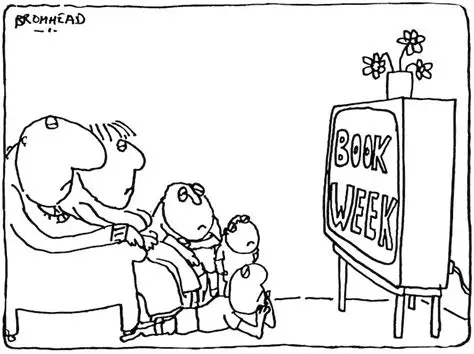
Because they are preoccupied with the issues and personalities of the period, many Bromhead's cartoons from the 1970s and '80s would be hard for someone who did not live through that era to understand. But a minority have even more pertinent in the twenty-first century. This is one of them.
Bromhead's family is sitting in front of the telly watching an item about New Zealand Book Week. 'The medium is the message', Marshall McLuhlan famously proclaimed. Here, though, medium and message clash. It undoubtedly made a certain sense to promote books on television, since television was so ubiquitous in New Zealand by the 1980s. But you couldn't read a book on television, and using television to promote literature symbolised the rise of the former at the expense of the latter.
Today we have TikTok stars who get millions of views for clips in which they advocate 'litmaxing', and wave around suspiciously shiny copies of On the Road or Moby Dick they claim to have read. We have interior designer youtubers who tell similarly large audiences how cool bookcases can make a lounge room look. And we have apps that 'summarise' literary classics in a few minutes for millions of students who don't want to read them.
The great works of literature are beginning to assume a place in our culture that the Bible once held in Catholic Europe. It is invoked for its gravitas and authority, but not actually read. The majority of Europeans in pre-Reformation Europe could not understand the Bible because they did not know Latin; in the twenty-first century many people who do pick up a book like Moby Dick find it inscrutable.
A recent survey found many lecturers in English literature at American colleges complaining that their students found it difficult to navigate texts that earlier generations sailed through. The relentless fragmentation of attention wrought by digital technology and social media has made the epic sentences of Melville or Joyce seem insuperable (the good news is that, with time away their screens and work, these students can repair their reading).
The brutal directness of Bromhead's style made him some enemies, and caused occasional controversies. Early in the '90s he was asked to draw cartoons for a pamphlet about mental health and suicide. He responded with a gun and the question: 'Thinking of topping yourself?' The pamphleteers found another artist.
Bromhead was never a cruel man, even if his cartoons were sometimes called cruel. He had a dislike for cant that he had learned growing up in working class Portsmouth. He associated directness with honesty, and distrusted elevated language and over-refined irony. Scratching a Living shows that he retained a contempt for the British class system and a pride in his origins long after crossing the world to escape them.
There is a sense of disappointment behind Bromhead's account of his career in Scratching a Living. After the 1980s his audience shrank and his work declined in quality. The Auckland Star became a victim of the neo-liberal policies Bromhead often skewered, and he lost the stimulus and discipline that came from drawing cartoons for a mass audience every day. In the twenty-first century he began to use colour and more detail, and the asperity of his earlier work was lost. But his work from the hurricane years of the '70s and '80s should always have an audience.


Comments