Book of the Week: kluge

Updated: Aug 19
pip adam, Te Herenga Waka University Press, 2026
Reviewed by Scott Hamilton
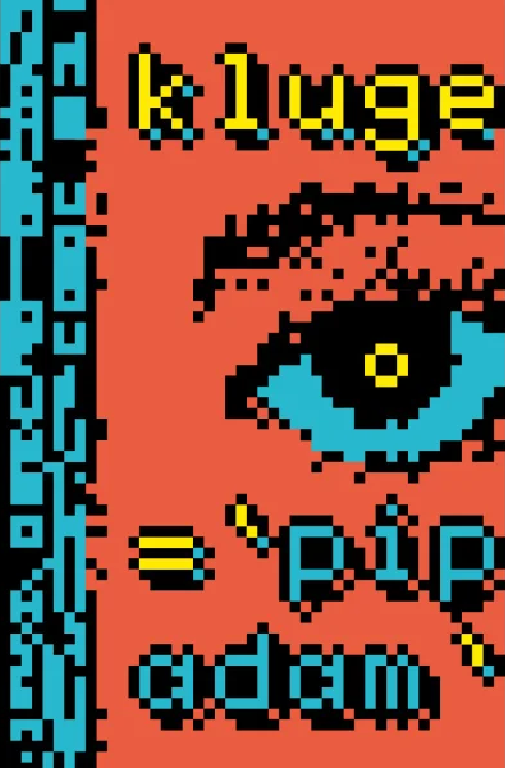
'No one else in New Zealand is writing like this' says Philip Matthews in an admiring review of pip adam's new novel kluge for Newsroom. Like the creators of modernism a century ago, pip adam is trying to find new ways of writing suitable for a new century. And like them she is addressing the crises of her century.
The academic industry that has grown up around modernist masterworks like TS Eliot's The Waste Land and James Joyce's Ulysses can obscure the fact that their authors were grabbing ideas and techniques from the media, from popular culture, and from new technologies like radio. They weren't working in ivory towers. Joyce ripped his stream of consciousness technique off a popular novel he found on a railway station's bookstall. Eliot scribbled down bits of dialogue he heard in London pubs and put them into The Waste Land. John Dos Passos inserted entire newspaper articles into his huge modernist novel USA.
And the modernists weren't making art for art's sake. They were all trying to deal with the crises of the early twentieth century: world war, the mutinies and proletarian uprisings bred by that war, and the decay of established religion and morality. Joyce made the hero of Ulysses a Jew in a riposte to anti-semitism and nationalism. Eliot wrote The Waste Land in fragments because he felt war had broken apart the world. If modernism was obscure it was because the world had become obscure. With the benefit of hindsight, we can see that the reviewers who dismissed Ulysses and The Waste Land as unreadable and alienating were really expressing their own inability or unwillingness to grapple with the twentieth century. They had expected Joyce and Eliot to deal with the 1900s in the forms of the 1800s, and were inevitably disappointed.
I wanted to talk about the great writers of the early twentieth century because adam and other twenty-first century literary innovators have sometimes faced the same complaints that the likes of Joyce and Eliot aroused. They've been called obscure and self-indulgent, and their horrified fascination with new forms of technology has been called faddish.
Reviewing pip adam's The New Animals for New Zealand Books in 2017, for example, Sue Macauley said that she had been 'in the mood' for 'familiarity' when she had opened the book, but had been sadly disappointed. The New Animals was too novel a novel for Macauley. She found its non-linear narrative and its unusual vocabulary unfamiliar, and therefore 'unfulfilling'. Anna Rogers made similar complaints about the novel in a review for The Listener. Another reviewer, Lisa Hill, predicted that adam's work would 'exasperate readers who don't like ambiguity'.
But life in the twenty-first century is often unfamiliar and alienating, and our responses to it can be deeply ambivalent. How can we not be alienated by twenty-first century capitalism, with its incomprehensible scale and tendency to boom or fall into crisis for inscrutable reasons? And how can we not have ambiguous feelings about twenty-first century technology, technology whose speed and reach can be both blessing and curse? The same devices that can save our lives by helping rescuers find us after an accident can ruin our lives by letting a stalker or bad employer track and torment us. A reader who is unwilling to suffer unfamiliarity and ambiguity is a reader who is unwilling to meet the twenty-first century in print.
In kluge and its predecessors, pip adam is taking forms of (mis)communication developed in the era of late capitalism—the AI 'summary', the political soundbite, the toxic social media post—and detourning them, so that they can carry the weight of literature.
kluge is narrated by some sort of artifical intelligence 'living' more than a century in the future. By mining footage it has found on old devices, the narrator has cobbled together the story of the multinational tech company it has long 'worked' for. We learn that the narrator has clashed with the boss of the company, who is refered to as HE/HIM and presented as a pretentious bully. Alarmingly, our AI friend has decided to present its story as an extended comedy routine. It's a large language model chewing through the corpus of David Brent. Perhaps it has also been fed Wittgenstein, who loved bad jokes and dreamed of writing a philosophical treatise that consisted exclusively of them. In his review Philip Mathews notes how familiar and unpleasant HE/HIM sounds—he is 'narcissistic, thin-skinned, needy, self-important'. Both he and the narrator are prone to sub-Nietzschean panegyrics to power and profit.
By creating her narrator and HE/HIM pip adam has set herself a problem. Many of us avoid the online effusions of tech bros like Musk and Sam Altman in the same desperate way we avoid the religious fanatic who shouts at us from the street corner, or the drunken guy who has brought bad breath and boring stories to a party. Why should we slog through a book dominated and narrated by such creatures? The answer, of course, is that the AI programme didn't really write kluge—adam did. She builds contradictions, slips, and silences into the narrative, inviting her readers become detectives, searching for truths that lie somewhere behind the text.
There's a parallel between kluge and Vladimir Nabokov's great and greatly puzzling novel Pale Fire, which purports to be a long commentary written by a demented scholar called Charles Zinbote about a rather straightforward poem by another man. Readers of Pale Fire are asked to guess at what facts might lurk behind Kinbote's weird interpretations of the poem and his stories and flights of rhetoric. In the same way, adam asks us to interrogate the narrative of kluge, and to guess at what the narrator's strained rhetoric and bad jokes might hide.
As Philip Mathews concedes, pip adam's work can be challenging. Matthews says he had to read the first half of her novel Audition five times before he understood it. My summary of kluge may be as unreliable as the book's narrative. But I think of TS Eliot's marvellous dictum: great poetry communicates before it is understood. Eliot's point can stand for other types of literature too, and even on a first reading kluge communicates a powerful unease about both AI and twenty-first century capitalism. pip adams' alienation from and dread of the system and its technology suffuse every page. I recognise her feelings.
Those writers who turn away from the twenty-first century and produce 'conventional' work will be easier to read, in the same way that, say, Rupert Brooke or Zane Grey were easier to read than TS Eliot or Joyce. But I doubt they'll be read with respect in a hundred years' time. pip adam may well be.


Comments