Bild a Rod! Or: Why We Love Hiroki

Updated: Jun 9
Scott Hamilton
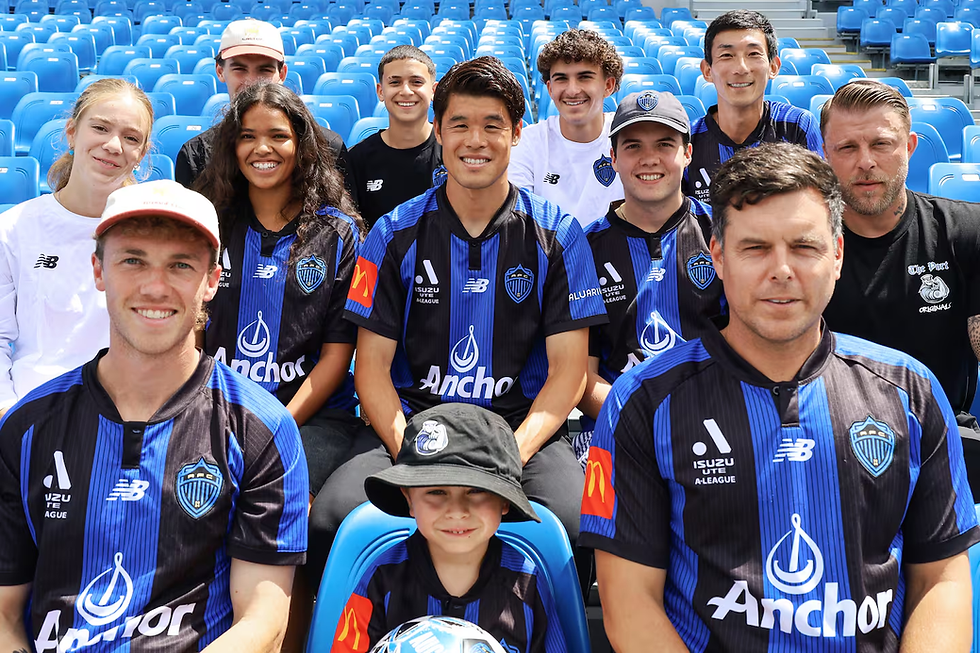
Winston Peters congratulated Auckland FC after the club won the final of the trans-Tasman A League competition. But our city's football team and their fans represent everything that Peters and his xenophobic followers abhor: cosmopolitanism, tolerance, and ebullience. Auckland FC captain Hiroki Sakai is Japanese, but over the last two seasons he's also become an Aucklander and an Aotearoan. His passion, exuberance, cheeky sense of humour, and kindness and patience with fans has won the hearts of Tamaki Makaurau. We love him.
Peters and his party insist that migrant Kiwis, especially those from 'non-Western' societies, can't belong to this country in the way that those of 'British' descent can. They talk of a mystical, chthonic 'New Zealand' culture that is being polluted by new arrivals. In 2026 targets are often Muslims, South Asians, and Africans. Fifty years ago Pacific Islanders were the obsession of our bigots; in the 19th and early 20th centuries Chinese, Irish and Dalmatians were bogeys. The aliens change; the xenophobia endures.
Auckland FC's players come from Aotearoa, Australia, the Pacific Islands, South America, Europe, and Asia. The team's home games have brought new demographic groups and a new fan culture into the sporting spotlight. I watched a lot of games of rugby and cricket growing up, but I never heard a fan sing, or beat a drum, or improvise a chant. Our sports audiences have long had a very Anglo-Saxon reserve. Like their counterparts in Latin America and Latin Europe, Auckland FC fans turn matches into festivals. Burgeoning migrant groups from South America, India, and Africa have come together at partied at Mount Smart. South American fans celebrate Auckland FC players like Uruguyan Guillermo May by flying flags from their continent. British migrants - long the backbone of football here - have adapted to the new atmosphere and 'Aucklandised' the Union Jack, giving it the club's colours.
There were parallels between the celebrations that followed Auckland FC's win and the huge parties of Arsenal fans a week earlier in Britain. Like Auckland, the Gunners have a multicultural fanbase. They unite black and white Britons, Jews and Muslims. The club's 'Arsenal for Everyone' campaign has promoted racial and religious tolerance. Both Arsenal and the England squad for the World Cup have in recent weeks become targets for Britain's far right, who think that teams should be selected on the basis of skin colour. 'Alternate' English squads for the World Cup featuring only pale players have circulated on social media.
Here in Aotearoa Peters' supporters bemoan changing demographics, claiming that a national identity based on 'whiteness' is being lost. But the cosmopolitanism of Auckland FC's players and supporters fits well with the history of Tamaki Makaurau. Auckland FC's fan club is called The Port, and the city's role as an anchorage has long defined it. Auckland has been part of an intricate web of trade and exchange that has included places as distant and different as Valparaiso, Rarotonga, San Francisco, and Singapore.
Polynesians made two-way journeys between their tropical homelands and Tamaki Makaurau, leaving tell-tale artefacts behind when they made pit stops at the Kermadecs and Norfolk. In the 19th century the Ngati Whatua marae at Okahu Bay regularly hosted voyagers from tropical Polynesia, as Cook Islanders, Hawai'ians, and members of many other societies arrived on whaling or trading ships. Members of the Kingitanga and Rarotongans traded goods and ideas about resistance to colonialism. From the 1890s onward, Auckland's wharfies and maritime workers were part of an international trade union network. Strikes spread across the ocean.
Thousands of Irish migrants to New Zealand arrived through the port and settled in the working class suburbs nearby. During World War One Fenian Irish were smuggled through the port to Australia, where conscription had been defeated in referenda, by maritime workers. Ideas as well as people flowed through the port. In the 19th and early 20th centuries the New Zealand state confiscated Fenian, feminist, and socialist literature at the docks. Pacific nationalists like Albert Henry, who would become the first Premier of the Cook Islands, sojourned in Auckland and received support and advice from wharfies and seafarers and other anti-colonial locals.
Later Auckland's airport came to be seen as a rival source of corruption and pollution by fearful bigots. The airport has been the route to a new life for generations of migrants. In his great and greatly influential essay 'Our Sea of Islands' Epeli Hau'ofa celebrated the Pacific Islanders arriving at airports like Auckland's as the heirs of a great voyaging tradition. They were travellers in vaka that used the air instead of water. The case of Hiroki Sakai shows the absurdity of xenophobes' attempts to restrict human identity and movement.
Sakai is Japanese - but he's also become an Aucklander. There is no contradiction between these two identities. They enrich him, and they enrich us. There's a phrase that I learned in Vanuatu that expresses this enrichment. I was talking to a Tannese man living on Efate, Vanuatu's capital island, and he'd asked where I was from. I explained that I was from Niu Zilan, but that my ancestors came from the Isle of Skye and Northern Ireland. I said I'd lived in Tonga and wanted to live in Vanuatu too.
'Yu bild a rod' he said, smiling and nodding. 'Yu bild a rod to Vanuatu.' I asked a local friend about the expression, and he told me that it expresses the way that ni-Vanuatu think of identity as something defined by relationships, but always under construction. We build roads by living. The place and community we grew up in, our ancestors: these are important to our identity. But we can expand ourselves by living in new places, and forming relationships with new people. My Tannese interlocutor had been a migrant worker in Te Wai Pounamu, picking grapes. So he had 'built a rod' to the New Zealand community where he'd lived, becoming a part of its Presbyterian church, making friends, going fishing with locals. These things had become part of him. But they didn't diminish his identity as Tannese & ni-Vanuatu.
This open-ended sense of identity has been emphasised by many Pacific thinkers, and noted by many scholars. In 'Our Sea of Islands' Hau'ofa shows the consciousness and identity of Pacific Islanders expanding, as they cross the ocean and settle in new lands, making the vastness of the region their own. The distinguished Tongan anthropologist 'Okusitino Mahina has created an influential 'ta va theory of reality', designed to capture the open-endedness of Pasifika identity. There is a radical distinction between this fluid, complex sense of self and the rigid, closed notion of identity emphasised by the far right in Aotearoa and in Europe. For the critics of Auckland FC and Arsenal's multiculturalism, an individual is formed and constrained by his or her locus and culture, and defined by his or her difference to those who were formed elsewhere. It is miserable understanding of the self that Winston Peters and his party appeal to. But Oceania offers us a richer and older alternative.

_


Comments